The production of electronics and semiconductors relies heavily on cleanrooms for quality and dependability. The tiniest particle, too small for the human eye to discern, can result in equipment damage, product flaws, or even the end of production. To maintain these carefully controlled environments, it takes planning, precision, and adherence to standards such as ISO 14644 and IEST-RP-CC018.
At Servicon, we recognize that contamination control is the first step towards successful microelectronics manufacturing. Particle benchmarks, daily and weekly cleaning protocols, and specific equipment maintenance are all included in this comprehensive cleanroom cleaning checklist designed for electronics and semiconductor operations.
Why Is Cleanroom Maintenance Important for the Production of Semiconductors?
A single contaminated particle can destroy an entire wafer or impair the functionality of a microchip during semiconductor manufacturing. Modern processors measure transistor sizes in nanometers, leaving virtually no room for error.
Potential dangers include dust, skin flakes, clothing fibers, and airborne ions. Contamination can alter electrical characteristics, reduce production rates, and result in significant financial losses if cleaning procedures are not followed. Additionally, contaminants may impede the operations of chemical vapor deposition, etching, or photolithography.
Contamination impacts worker safety, compliance, and product quality. ISO Class 3 to Class 8 standards, each with particular air particle restrictions, apply to semiconductor cleanrooms. Regular expert cleaning ensures those boundaries are consistently met, safeguarding both goods and workers.
Who Offers Medical Device and Semiconductor Companies Certified Cleanroom Cleaning Services?
Cleaning a cleanroom requires specialized knowledge, equipment, and training. Not all cleaning services can do this. Facilities that manufacture aerospace components, medical devices, or semiconductors need to employ skilled technicians who are aware of contamination control procedures.
Servicon is a pioneer in cleanroom cleaning for highly regulated businesses that comply with GMP, ISO, and ESD standards. Our staff members have received training on using sterile, lint-free materials, handling Class 1 to Class 9 cleanrooms, and adhering to authorized gowning protocols. To guarantee adherence to internal and external standards, we work closely with cleanroom managers, quality teams, and EH&S officers.
Servicon supplies the necessary documents, training records, and process checks to meet FDA, ISO 13485, and IEST standards for medical device companies or electronics manufacturers seeking certification assistance.

What Needs to Be on a Checklist for Daily Cleanroom Cleaning?
Daily chores that prevent the buildup of residues and particles are the first step in a dependable cleaning regimen. To prevent contaminants from spreading, each step must move in a single direction from the cleanest area to the least clean area.
Among the daily cleaning duties are:
- Cleaning of the entryway: Before production begins, mop and clean the pass-throughs, airlocks, and gowning spaces.
- Surface wipe-down: Use lint-free, pre-saturated wipes with authorized solvents or disinfectants to clean work surfaces, benches, and equipment exteriors.
- Floor maintenance: Use sterile solutions, such as deionized water combined with an antistatic agent, and cleanroom-approved mops. After every use, change the mop heads.
- High-touch points: Use IPA wipes to clean control panels, light switches, and door handles.
- Removal of waste: Use cleanroom-rated, anti-static bags and replace them daily.
- Particle monitoring: To verify adherence to ISO guidelines, count the number of particles in specified areas.
Certified technicians dressed in complete cleanroom uniforms carry out these duties. To ensure compliance and traceability, each action is recorded in the cleaning log.
A Weekly Cleanroom Cleaning Checklist: What Should It Include?
Weekly tasks provide deeper cleaning and attention to areas not included in the daily routine. The production volume, particle monitoring outcomes, and the facility’s risk profile could all affect this timeline.
Among the weekly cleaning duties are:
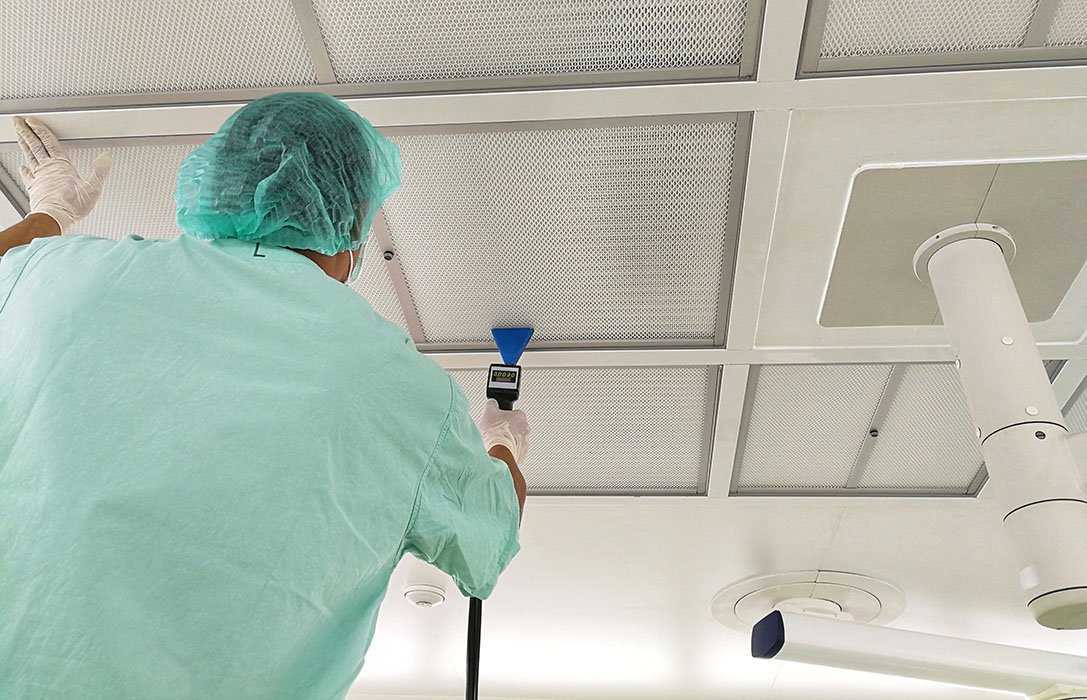
- Ceiling and lighting panels: To remove dust buildup, use lint-free wipes approved for cleanroom use and extendable cleanroom equipment.
- Windows and walls: Use a detergent solution or sterile solvent to wipe from top to bottom, being sure to dry completely.
- Bases and undersides of equipment: When feasible, move portable equipment to thoroughly clean bases and floors.
- Air vents and filters: Inspect for accumulation in the prefilters and HEPA filter housings. As directed by maintenance plans, clean or replace.
- Laminar flow hoods and benches: As per SOPs, remove the exterior covers and clean the inside surfaces.
- ESD flooring checks: Verify that static dissipation stays within tolerance by measuring resistance.
Facilities maintain consistent compliance and reduce downtime by switching between daily and weekly cleaning procedures.

What Are the Semiconductor Cleanroom Particle Count Benchmarks?
The key indicator of cleanroom efficacy is particle control. The maximum permitted number of particles per cubic meter of air at various particle sizes is specified in the ISO 14644-1 standard.
Regarding cleanrooms for semiconductors:
- Up to 1,000 particles ≥0.1 microns per cubic meter are included in ISO Class 3
- Up to 10,000 particles ≥0.1 microns per cubic meter are included in ISO Class 4
- Up to 100,000 particles ≥0.1 microns per cubic meter are included in ISO Class 5.
At regular intervals, calibrated airborne particle counters are used to track particle counts. Cleaning frequency is increased, and environmental conditions are examined if counts exceed the predetermined threshold.
Real-time trend tracking by Servicon specialists enables facilities to spot potential issues such as deteriorating filters, increased foot traffic, or contaminated processes before they affect output.
How Do Mopping and Wipe-Down Procedures Get Done Without Polluting the Cleanroom?
To guarantee that contaminants are not introduced during the cleaning process, a cleanroom must be cleaned precisely. Each wipe, mop, and action follows a pattern intended to eliminate debris while preserving the integrity of the laminar airflow.
The right way to wipe things down:
- Make use of low-lint, sterile wipes soaked in a cleaning solution that the cleanroom has approved
- With each pass, fold the wipes to reveal a clean side
- Only wipe in one direction, somewhat overlapping
- Used wipes should be disposed of right away in containers designated for cleanroom use.
The right way to mop:
- Use cleanroom-specific flat mops with sealed edges and replaceable covers
- Apply an approved cleaning solution in an “S” pattern, working from the cleanest zone outward
- Change mop heads between rooms or zones to prevent cross-contamination.
Each cleaning solution must be compatible with surface materials and approved for use in electrostatic discharge (ESD)-sensitive environments.

What Equipment and Materials Are Used for Cleanroom Maintenance?
Only materials designed for cleanroom environments should be used. These items are engineered to minimize particle shedding and resist static buildup.
Common equipment and materials include:
- HEPA-filtered vacuums: Used to remove fine particulates from floors and equipment.
- Lint-free wipes and mop heads: Made from polyester or non-woven blends.
- Cleanroom detergents and solvents: Typically include isopropyl alcohol, neutral detergents, or specialized antistatic solutions.
- Stainless-steel cleaning carts: Easy to disinfect and corrosion-resistant.
- Disposable garments and gloves: Prevent human-borne contamination.
- Particle counters and surface monitors: Verify environmental cleanliness in real time.
Servicon’s cleanroom cleaning teams use validated tools and solutions that meet the strictest industry standards for semiconductor, aerospace, and medical device manufacturing.
Which Industries Require Professional Cleanroom Cleaning Services?
While semiconductor and electronics manufacturing are among the most contamination-sensitive industries, many others depend on professional cleanroom cleaning. These include:
- Pharmaceutical and biotechnology production facilities following GMP and FDA standards
- Medical device manufacturing under ISO 13485 requirements
- Aerospace and defense component assembly
- Optics and nanotechnology research environments
- Battery and EV component production facilities.
Each industry has its own regulatory and operational requirements, but they all share one common need: expert contamination control performed by trained professionals. Servicon’s cleanroom cleaning services are designed to adapt to each industry’s standards while maintaining efficiency and consistency.
Partnering with Servicon for Semiconductor Cleanroom Care
Cleanrooms are not just technical spaces; they are the heart of high-precision manufacturing. Keeping them in top condition requires a disciplined approach, verified results, and ongoing expertise.
Servicon provides certified cleanroom cleaning services that help electronics and semiconductor manufacturers maintain compliance, reduce downtime, and protect yield integrity. Our technicians receive continuous training, follow validated cleaning SOPs, and use advanced monitoring tools to deliver measurable results.
From daily wipe-downs to quarterly deep cleans, Servicon ensures every surface, vent, and workstation meets the standards demanded by the most exacting industries.